Send 14 or 15 troops to Norway? Both campaigns, played to victory
Leaving more troops in a captured province leaves fewer at home. We compared two Nordic starts that first differ by one soldier’s destination, then followed both campaigns to their actual endings.
Setup: Nordic 20 turns · Sweden · Normal · New game · Delegation off.
Both starts recruit five infantry in Sweden on turn 1. The first difference is sending 14 or 15 troops to Norway on turn 2. Subsequent choices follow the same decision rule, but produce different action sequences.
Use ordinary ‘Declare war’, not the war limited to capturing Norway. The latter ends in a truce after capture and changes these conditions. Restored saves and extra actions can also change the results.
Start a Nordic game · Read the opening economy comparison
1. Compare what remains at both ends
After recruiting on turn 1 and ending the turn, Sweden has 16 troops and 8 gold. Norway has 11 troops plus 2 defense on turn 2. After declaring ordinary war, the minimum winning dispatch at this point is 14 troops.
| Sent | Left in Sweden | Left in Norway |
|---|---|---|
| 14 | 2 | 1 |
| 15 | 1 | 2 |
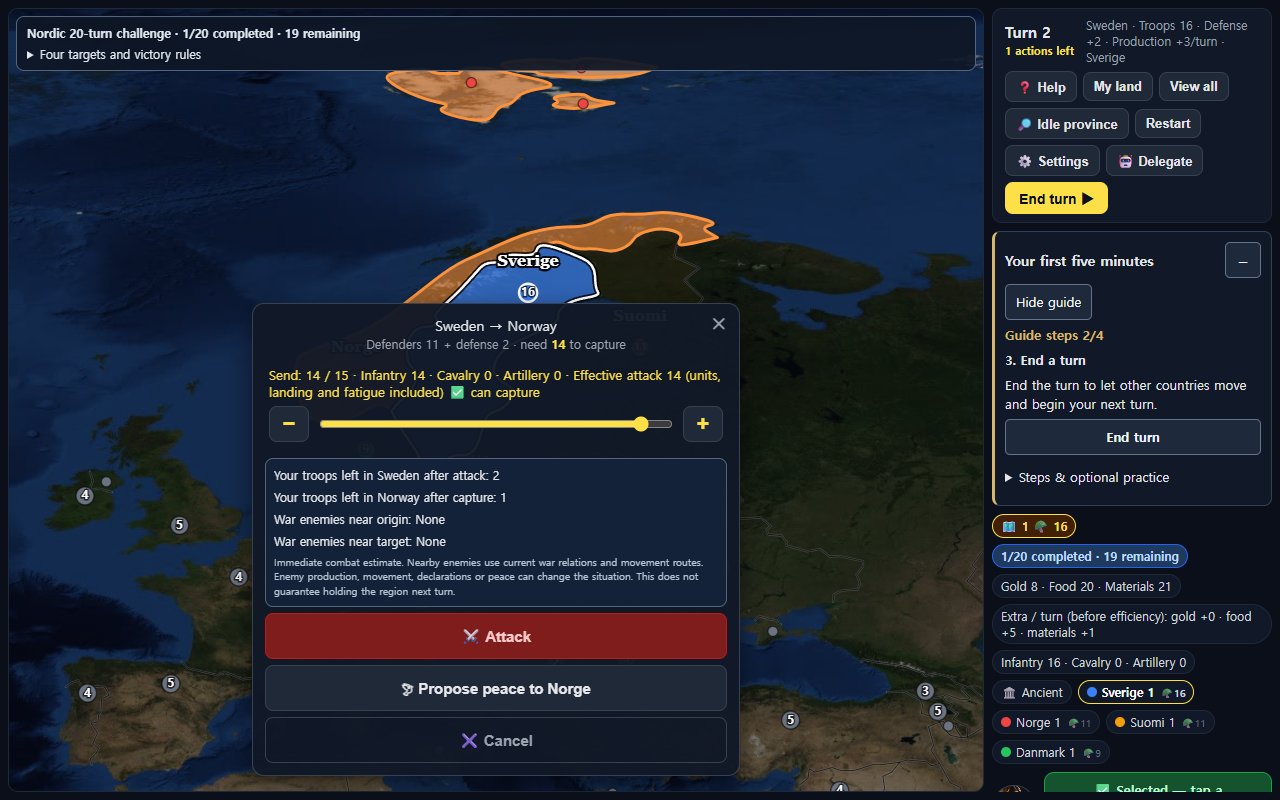
On turn 3, the 14-troop route has Sweden 5 / Norway 4, while the 15-troop route has Sweden 4 / Norway 5. Both retained both regions. Norway’s one-soldier garrison was not recaptured in this run. That is not evidence that a one-soldier garrison is safe against different neighbors, eras or diplomatic relationships.
2. Sending 14: victory after four completed turns
| Turn | Actions taken |
|---|---|
| 1 | Recruit 5 infantry in Sweden. End turn. |
| 2 | Declare ordinary war on Norge. Attack Norway from Sweden with 14 troops. End turn. |
| 3 | Recruit 5 infantry in Norway, then 5 in Sweden. End turn. |
| 4 | Attack Denmark from Norway with 6, then Finland from Sweden with 12. End turn. |
| 5 | Victory after holding all four targets through the enemy phase. No further action. |
On turn 3 neither province could capture a target under the decision rule, so both recruited. Denmark and Finland were already at war with us on turn 4. If your screen shows peace or a truce, your run differs: check diplomacy before trying to follow those attacks.
3. Sending 15: Denmark sooner, Finland later
| Turn | Actions taken |
|---|---|
| 1 | Recruit 5 infantry in Sweden. End turn. |
| 2 | Declare ordinary war on Norge. Attack Norway from Sweden with 15 troops. End turn. |
| 3 | Declare ordinary war on Danmark. Attack Denmark from Norway with 4. Recruit 5 infantry in Sweden. End turn. |
| 4 | Recruit 5 infantry in Norway, then 5 in Sweden. End turn. |
| 5 | Attack Finland from Norway with 4. Recruit 5 infantry in Sweden. End turn. |
| 6 | Victory after holding all four targets through the enemy phase. No further action. |
The extra soldier in Norway enabled the Denmark attack on turn 3. However, Sweden had only 12 troops on turn 4, so it could send at most 11 while leaving one behind. Finland required 12 at that point, so Sweden recruited again. In this example, capturing Denmark sooner still led to a victory one turn later.
4. Actual endings and what they establish
| First dispatch | Completed turns | Troops in targets | Gold | Outcome |
|---|---|---|---|---|
| 14 | 4 | 19 | 17 | Victory |
| 15 | 5 | 47 | 13 | Victory |
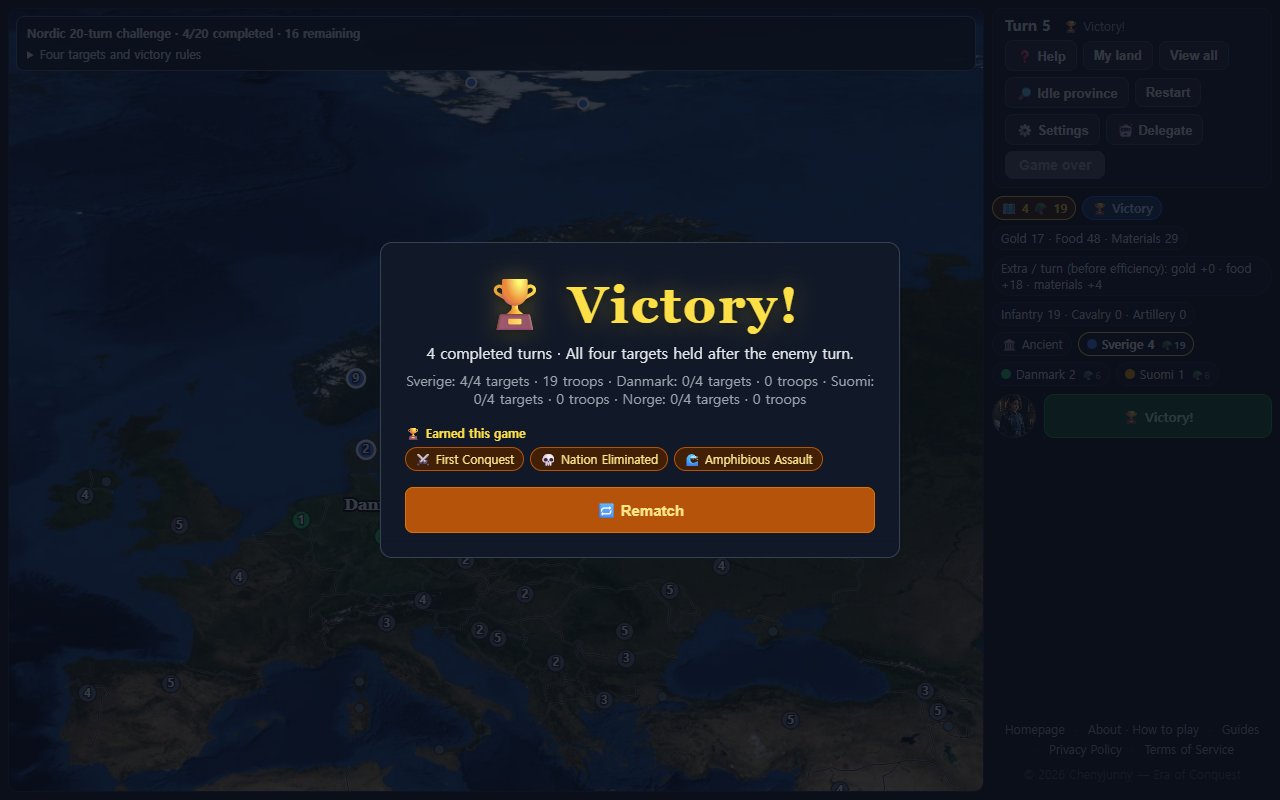
These routes trade a quicker finish against more surviving troops. They do not establish that minimum dispatches always win. When nearby countries are at war and can attack, compare the vulnerability of both your source province and the new garrison.
How did we execute and verify the comparison?
Each run starts fresh. We inspect actionable owned provinces by ID, then reachable Nordic targets by troops plus defense, with ID breaking ties. Capture with the minimum winning force when legal; otherwise recruit infantry if affordable. Only the turn-2 Norway dispatch is overridden to 14 or 15. Ordinary war is declared as needed without breaking treaties.
We replayed the resulting action lists in local Chrome in Korean and English, comparing owners, troops, turn and winner after recruitment, attacks and end turns. Province selection, attacks and end turns also use test-only game functions. This is not a measurement of human play time or proof of an optimal strategy.